
EPCs and the law
Are Energy Performance Certificates compulsory?
For most properties placed on the market in England and Wales — whether residential or commercial, for sale or to let — it is now a legal requirement to have a valid Energy Performance Certificate (EPC).
In this article, we explain what an EPC is, when one is required, and what the implications can be if a property receives a low rating.
What is an EPC?
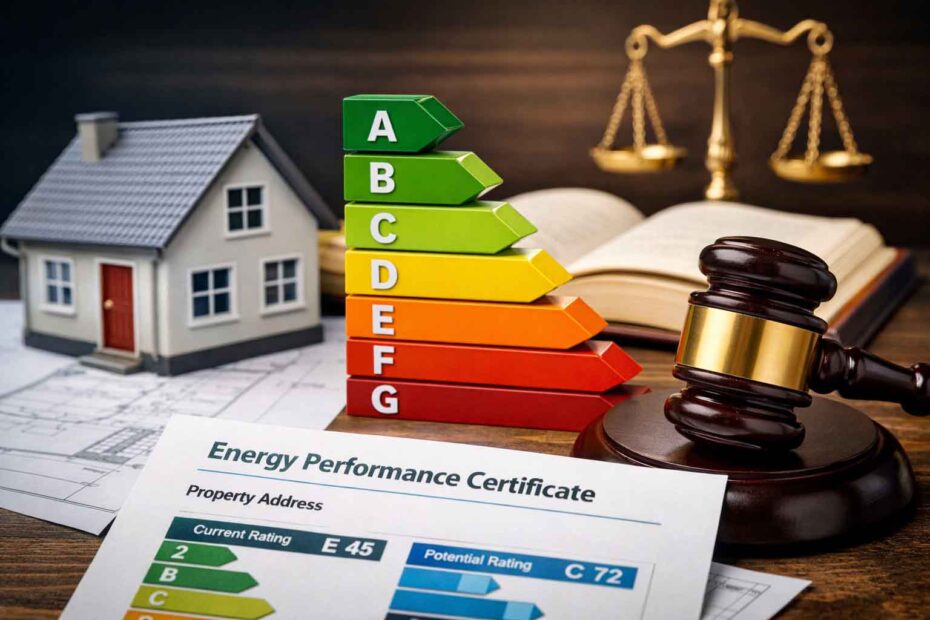
An EPC measures the energy efficiency of a building. This assessment covers factors such as insulation, heating and hot water systems, and the use of energy-saving lighting. Properties that are less energy efficient typically cost more to run, resulting in higher energy bills.
The certificate also includes:
- The current energy efficiency rating
- A potential rating if recommended improvements are carried out
- An environmental impact score
An EPC is required for most properties when they are sold or let. Certificates are valid for ten years, after which a new EPC must be obtained before the property can be marketed again.
Which properties require an EPC?
As a general rule, all residential and commercial properties must have a valid EPC before being marketed. However, there are a number of exemptions.
Since January 2013, listed buildings have benefited from a conditional exemption. This applies only where meeting minimum energy efficiency requirements would unacceptably alter the building’s character or appearance. The exemption relates to improvement works that would normally fall under Part L of the Building Regulations (Conservation of Fuel and Power) and would typically appear in the recommendations section of an EPC. If such works would harm the building’s historic integrity, the exemption may apply.
Other categories of exempt property include:
- Places of worship
- Temporary buildings with a planned use of less than two years
- Stand-alone buildings with a total floor area under 50 square metres
- Industrial sites, workshops and non-residential agricultural buildings with low energy use
- Holiday lets rented for fewer than four months per year
- Residential buildings intended to be occupied for less than four months annually
- Unsafe properties that pose a serious health or safety risk
- Buildings due for demolition, where all relevant consents and documentation are in place
EPCs and the private rented sector
In 2016, the Energy Efficiency (Private Rented Property) (England and Wales) Regulations 2015 introduced Minimum Energy Efficiency Standards (MEES) for both residential and commercial privately rented properties.
These regulations were designed to raise the standard of rental accommodation and help reduce carbon emissions in line with the UK’s decarbonisation targets. From 1 April 2018, it became unlawful to grant a new tenancy on a property with an EPC rating below band E.
Landlords and managing agents should therefore ensure an up-to-date EPC is in place, as ratings can change over time. The report will confirm the current rating and highlight recommended improvements.
Can a property be exempt from EPC requirements?
Yes. While properties with an EPC rating below E are generally prohibited from being let, several exemptions are available.
Where a property qualifies for an exemption, the landlord must register it on the PRS Exemptions Register before continuing to let the property.
Types of EPC exemption
There are six recognised exemptions that can be registered:
All relevant improvements made
This applies where all recommended improvements have been carried out up to the cost cap of £3,500 (including VAT), yet the property still fails to reach an EPC rating of E, or where no improvements are possible.
High cost exemption
This can be claimed if even the least expensive recommended improvement would exceed the £3,500 cost cap (inclusive of VAT).
Wall insulation exemption
This applies where the only recommended measures are:
- Cavity wall insulation
- External wall insulation
- Internal wall insulation (to external walls)
Third-party consent exemption
Where improvement works require consent from a third party — such as a superior landlord, freeholder, mortgage lender or planning authority — and that consent cannot be obtained despite reasonable efforts, or is only granted subject to unreasonable conditions.
Property devaluation exemption
This can be registered if evidence shows that carrying out the recommended energy efficiency works would reduce the property’s market value by more than 5%.
Temporary exemption for new landlords
Where a person becomes a landlord under specific circumstances, they may be granted a temporary exemption of up to six months from the date they acquire the property, allowing time before improvements are required.
Frequently Asked Questions
1. Do I need an EPC before marketing my property?
Yes. In most cases, a valid Energy Performance Certificate must be in place before a property is marketed for sale or rent. This applies to both residential and commercial properties, unless a specific exemption applies.
2. How long does an EPC remain valid?
An EPC is valid for 10 years from the date it is issued. Once it expires, a new EPC must be obtained before the property can be sold or let again.
3. What happens if my rental property has an EPC rating below E?
Under the Minimum Energy Efficiency Standards (MEES), it is generally unlawful to let a property with an EPC rating below E. However, landlords may be able to continue letting the property if a valid exemption is registered on the PRS Exemptions Register.
4. Are listed buildings exempt from EPC requirements?
Listed buildings may be exempt, but this exemption is not automatic. It only applies where making energy efficiency improvements would unacceptably alter the building’s character or appearance. Each case must be considered on its own merits.
5. How do I register an EPC exemption?
If your property qualifies for an exemption, you must register it on the Private Rented Sector (PRS) Exemptions Register. Evidence supporting the exemption must be provided, and exemptions are usually time-limited.